Museum
Chen Shuren Memorial Hall
- Mo
- Geschlossen
- Di
- 09:30–17:00
- Mi
- 09:30–17:00
- Do
- 09:30–17:00
- Fr
- 09:30–17:00
- Öffnungszeiten
- The official source states that the hall is closed on Mondays; Saturday and Sunday hours were not specified.
- Preis
- Admission is free.
- Besuchshinweise
- The building has permanent exhibitions on three floors, with a garden nearby.
- Öffnungszeiten
- Freier Eintritt
- Öffnungszeiten
- Etwa 60–120 Min.

Warum der Umweg sich lohnt
Chen Shuren purchased this ground in 1927 and built his private garden residence, Chuyuan, only for the compound to be destroyed during the war. The present memorial was constructed on the lost garden’s site in 1987, preserving the memory of a painter who moved constantly between revolutionary politics and delicate landscapes, birds, and flowers.
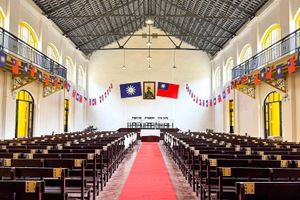
The Chen Shuren Memorial Hall is a museum dedicated to the life and work of Chen Shuren, a painter known for his delicate landscapes and involvement in revolutionary politics. Built on the site of his former garden residence, it offers insight into his artistic and political legacy.
Die Menschen hinter dieser Adresse
Belegte Verbindungen, keine Promi-Anekdoten.
Chen Shuren
He built and occupied the original Chuyuan residence on this site before it was destroyed in wartime.
Was sonst in der Nähe liegt
Die nächstgelegenen Orte, über die wir geschrieben haben, mit Luftlinie von hier.
500 m
Dongshankou and Xinhepu
Early-20th-century villa quarter in Dongshan, walked from the Xinhepu streets.
500 m
Sun Yat-sen Medical and Revolutionary Activity Memorial
This monument and surviving hospital buildings commemorate the place where Sun Yat-sen began studying Western medicine in Guangzhou. The protected site's official name also identifies the hospital as a seedbed of his early revolutionary activity, joining the future physician and political revolutionary in one compact campus. ([wglj.gz.gov.cn](https://wglj.gz.gov.cn/visitgz/f/res/doc/%E5%8C%97%E4%BA%AC%E8%B7%AF%E6%96%87%E5%8C%96%E6%A0%B8%E5%BF%83%E5%8C%BA%E5%AF%BC%E6%B8%B8%E8%AF%8D.pdf?utm_source=openai))
1.0 km
Guangdong Cantonese Opera Theatre
The company based here grew from the Guangdong Cantonese Opera Troupe and was formally established as an academy-level theatre in 1958 under its first president, Ma Sze-tsang. Its institutional legend rests on the 1956 Beijing performance of The Search for the Academy by Ma and Hongxiannü, an event that helped elevate Cantonese opera from regional entertainment to nationally celebrated theatre.
1.9 km
Former Site of the All-China Federation of Trade Unions
The former Huizhou Guild Hall served first as Kuomintang headquarters, where Liao Zhongkai was assassinated at the entrance in August 1925. Weeks later it became the headquarters of the All-China Federation of Trade Unions, turning the scene of a political murder into the command center of a surging national labor movement. ([szb.zhku.edu.cn](https://szb.zhku.edu.cn/phone/content.aspx?id=831&utm_source=openai))
1.9 km
Former Site of the First National Congress of the Kuomintang
Sun Yat-sen convened the Kuomintang's transformative 1924 congress inside this clock-towered school building, formalizing cooperation with Chinese Communists and the policies of alliance with Soviet Russia and support for workers and peasants. Three years later Lu Xun lived in the same building and wrote about its old clock tower, giving the revolutionary venue an unexpected literary afterlife. ([wglj.gz.gov.cn](https://wglj.gz.gov.cn/visitgz/f/res/doc/%E5%8C%97%E4%BA%AC%E8%B7%AF%E6%96%87%E5%8C%96%E6%A0%B8%E5%BF%83%E5%8C%BA%E5%AF%BC%E6%B8%B8%E8%AF%8D.pdf?utm_source=openai))
1.9 km
Canton–Hong Kong Strike Committee Site
In 1925 striking workers transformed a former admiral's garden into the headquarters of the Canton–Hong Kong general strike, erecting simple bamboo and palm shelters across the grounds. Most buildings were destroyed by arson in 1926, leaving the old gate and a tree as rare witnesses before the red headquarters building was reconstructed on its original site. ([yuexiu.gov.cn](https://www.yuexiu.gov.cn/jjjc/ljjy/jyjd/content/post_10520138.html?utm_source=openai))



Mit den Geschichten ablaufen
Diese Adresse ist eine Station von vielen. Unsere Routen und Quests verbinden sie zu einem Weg, der vor Ort aufgeht.