Literature

Alexander von Humboldt

1769–1859Known worldwide

His scientific exploration, quantitative research, and influential view of nature as an interconnected whole.

Alexander von Humboldt

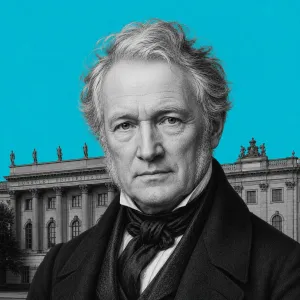
Alexander von Humboldt was a German polymath, geographer, naturalist, explorer, and writer. His quantitative research helped establish biogeography, while his systematic measurements contributed to modern geomagnetic and meteorological monitoring. In his multivolume work "Kosmos," he sought to unite scientific knowledge and culture. He is depicted at Berlin's Humboldt Forum.

Worth knowing

A founder of modern geography

Humboldt's quantitative work on the geographical distribution of plants helped lay the foundations of biogeography. Together with Carl Ritter, he is regarded as a founder of modern geography as an independent scientific discipline.

Across the Americas

Between 1799 and 1804, Humboldt travelled thousands of miles through the Americas with the French explorer Aimé Bonpland. In 1802, he climbed a mountain in Ecuador to 19,286 feet, then a record altitude for a Westerner.

The vision of Kosmos

Humboldt revived the ancient Greek word "cosmos" for his multivolume treatise "Kosmos." The work brought together branches of science and culture and presented the universe as an interacting whole, contributing to ecological and environmental thought.

Humboldt at the Humboldt Forum

Alexander von Humboldt is depicted at Berlin's Humboldt Forum.

Addresses you can still visit

Every place in this city with a documented tie to this person.

  • Commemorated here

    Humboldt Forum

    Berlin’s museum of human history, art and culture, housed in the Berlin Palace and often described as Germany’s answer to the British Museum.

Follow the story on foot

These addresses are scattered across the city. Our routes and quests put them in an order that works.

See routes in this city