Exile from Germany
When the Nazis came to power in 1933, Brecht fled Germany, initially for Scandinavia. During the Second World War, he moved to Southern California, where he worked as a screenwriter while under FBI surveillance.
Literature · Music
A leading theorist of epic theatre, later called dialectical theatre, and the Verfremdungseffekt.
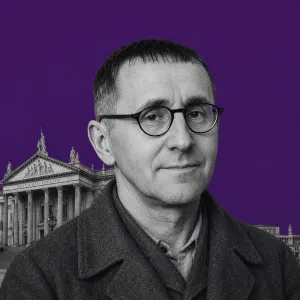
Bertolt Brecht was a German theatre practitioner, playwright, and poet. He moved to Berlin in 1924, where he wrote The Threepenny Opera with Elisabeth Hauptmann and Kurt Weill and began a lifelong collaboration with composer Hanns Eisler. Influenced by Marxist thought, he wrote didactic Lehrstücke and developed his theories of epic theatre. After years in exile, he settled in East Berlin and co-founded the Berliner Ensemble with Helene Weigel.
When the Nazis came to power in 1933, Brecht fled Germany, initially for Scandinavia. During the Second World War, he moved to Southern California, where he worked as a screenwriter while under FBI surveillance.
The Threepenny Opera received its world premiere at Berlin’s Theater am Schiffbauerdamm in 1928. Brecht wrote the work with Elisabeth Hauptmann and composer Kurt Weill.
In 1947, Brecht was among the first Hollywood film artists subpoenaed by the House Un-American Activities Committee over alleged Communist Party affiliations. He returned to Europe the day after testifying.
After returning to Europe, Brecht eventually settled in East Berlin. There he co-founded the Berliner Ensemble with his wife and long-time collaborator, actress Helene Weigel.
Brecht is buried in Berlin’s Dorotheenstadt Cemetery.
Every place in this city with a documented tie to this person.
Burial place
A late-18th-century Protestant cemetery in central Berlin, known for its compact historic grounds and its remarkable next-door neighbor: the Brecht House.
Created here
His Threepenny Opera received its world premiere on this stage in 1928.
These addresses are scattered across the city. Our routes and quests put them in an order that works.

