A philosopher shaped by political change
Born in Stuttgart in 1770, Hegel lived between the Enlightenment and the Romantic movement. The French Revolution and the Napoleonic wars helped shape his thought.
Literature
Developing a comprehensive philosophical system, often called absolute idealism, centred on spirit, history and freedom.
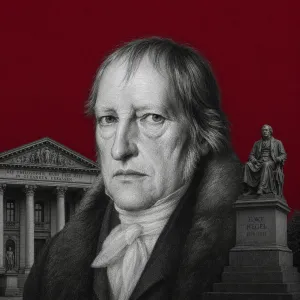
Georg Wilhelm Friedrich Hegel (1770–1831) was a German philosopher and a major figure in German idealism. Influenced by the French Revolution and the Napoleonic wars, he examined metaphysics, politics, art and religion. His academic career culminated in the chair of philosophy at the University of Berlin. He is buried at Dorotheenstadt Cemetery in Berlin.
Born in Stuttgart in 1770, Hegel lived between the Enlightenment and the Romantic movement. The French Revolution and the Napoleonic wars helped shape his thought.
In major works including Phenomenology of Spirit (1807) and Science of Logic (1812–1816), Hegel presented reality as a unified whole. His concept of spirit, or Geist, describes humankind coming to know itself through a historical process of rational development.
In his political philosophy, Hegel asserted that “world history is progress in the consciousness of freedom.”
Hegel is buried at Dorotheenstadt Cemetery in Berlin. After his death, his followers divided into Right and Left Hegelian camps, while his thought later influenced critical theory and became a major reference point for existentialism.
Every place in this city with a documented tie to this person.
Burial place
A late-18th-century Protestant cemetery in central Berlin, known for its compact historic grounds and its remarkable next-door neighbor: the Brecht House.
These addresses are scattered across the city. Our routes and quests put them in an order that works.
