An unexpected heir
As the second son of Prince Frederick William and Louise of Mecklenburg-Strelitz, Wilhelm was not expected to inherit the throne. When his childless elder brother became king in 1840, Wilhelm became heir presumptive.
Literature
The first German Emperor and King of Prussia during the unification of Germany in 1871.
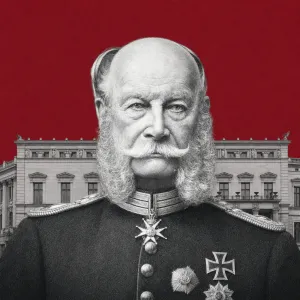
Wilhelm I was King of Prussia from 1861 and German Emperor from 1871 until his death in 1888. A member of the House of Hohenzollern and a prominent figure in the Prussian Army, he became heir when his childless elder brother took the throne. He oversaw Prussia’s rise as the leading German power and largely left government affairs to Otto von Bismarck. Berlin’s Kaiser Wilhelm Memorial Church is named after him.
As the second son of Prince Frederick William and Louise of Mecklenburg-Strelitz, Wilhelm was not expected to inherit the throne. When his childless elder brother became king in 1840, Wilhelm became heir presumptive.
Wilhelm played a major role in suppressing the Revolutions of 1848 in Germany and was briefly forced into exile in England.
Wilhelm oversaw Prussian victories in the Second Schleswig War and the Austro-Prussian War. After the Franco-Prussian War and Bismarck’s political maneuvers brought about German unification, Wilhelm received the title of German Emperor in 1871.
Berlin’s Kaiser Wilhelm Memorial Church is named after Wilhelm I.
Every place in this city with a documented tie to this person.
Commemorated here
A western Berlin landmark that pairs the bomb-damaged spire of a 19th-century church with a modern church complex built around it.
These addresses are scattered across the city. Our routes and quests put them in an order that works.
