Scholar and public servant
Humboldt combined intellectual work with public service as a government functionary and diplomat. He made contributions to philosophy, linguistics, ethnolinguistics, and educational theory.
Literature
Developing the Humboldtian ideal of education, which emphasized realizing individual potential rather than preparing people for fixed occupations or social roles.
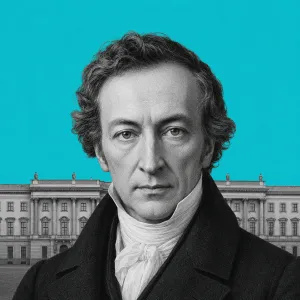
Wilhelm von Humboldt was a Prussian philosopher, linguist, writer, diplomat, and government functionary. Born in 1767, he contributed to the philosophy of language, ethnolinguistics, and educational theory. He founded the institution now known as Humboldt University of Berlin, which was named after him and his younger brother Alexander in 1949.
Humboldt combined intellectual work with public service as a government functionary and diplomat. He made contributions to philosophy, linguistics, ethnolinguistics, and educational theory.
Humboldt viewed education as a means of realizing individual potential rather than drilling traditional ideas into young people or preparing them for established occupations and social roles.
The Humboldtian ideal became a model for Prussia's public education system and was also used as an educational model in the United States and Japan.
The Humboldt Forum in Berlin is linked to Wilhelm von Humboldt as a namesake.
Every place in this city with a documented tie to this person.
Commemorated here
Berlin’s museum of human history, art and culture, housed in the Berlin Palace and often described as Germany’s answer to the British Museum.
These addresses are scattered across the city. Our routes and quests put them in an order that works.
