Museum
Liao Zhongkai and He Xiangning Memorial Museum
- Mon
- Closed
- Tue
- Closed
- Wed
- Closed
- Thu
- Closed
- Fri
- Closed
- Sat
- Closed
- Sun
- Closed
- Hours
- Since August 28, 2026, the museum has been closed to the public for renovation; no reopening date is stated.
- Price
- CNY 0 — admission is free.
- How to visit
- The museum is currently unavailable to visitors because of renovation. Previously, individual visitors only had to register their personal information at the front desk; photography in the exhibition area was generally prohibited.
- Hours
- Free entry
- Hours
- About 45 min

Why it is worth the detour
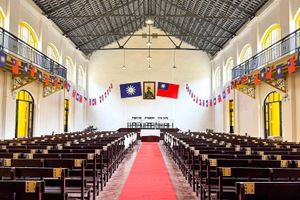
The museum occupies the former offices of the agricultural and industrial school that He Xiangning established as a living memorial to her assassinated husband. Its story is less a static tribute than a widow's political response: she converted grief into a school meant to train a new generation for national reconstruction. ([jng.zhku.edu.cn](https://jng.zhku.edu.cn/lxwm.htm?utm_source=openai))
The Liao Zhongkai and He Xiangning Memorial Museum occupies the former offices of an agricultural and industrial school. It serves as a tribute and a political response by He Xiangning to train a new generation for national reconstruction.
The people behind this address
Documented connections, not celebrity trivia.
He Xiangning
She founded the Zhongkai Agricultural and Industrial School in memory of Liao Zhongkai. ([szb.zhku.edu.cn](https://szb.zhku.edu.cn/phone/content.aspx?id=116&utm_source=openai))
What else is close by
The nearest places we have written up, with straight-line distance from here.
150 m
Memorial Museum of Generalissimo Sun Yat-sen's Mansion
The Memorial Museum of Generalissimo Sun Yat-sen's Mansion is known for being a historical site where Sun Yat-sen established his military headquarters.
1.1 km
Canton–Hong Kong Strike Committee Site
In 1925 striking workers transformed a former admiral's garden into the headquarters of the Canton–Hong Kong general strike, erecting simple bamboo and palm shelters across the grounds. Most buildings were destroyed by arson in 1926, leaving the old gate and a tree as rare witnesses before the red headquarters building was reconstructed on its original site. ([yuexiu.gov.cn](https://www.yuexiu.gov.cn/jjjc/ljjy/jyjd/content/post_10520138.html?utm_source=openai))
1.2 km
Former Site of the All-China Federation of Trade Unions
The former Huizhou Guild Hall served first as Kuomintang headquarters, where Liao Zhongkai was assassinated at the entrance in August 1925. Weeks later it became the headquarters of the All-China Federation of Trade Unions, turning the scene of a political murder into the command center of a surging national labor movement. ([szb.zhku.edu.cn](https://szb.zhku.edu.cn/phone/content.aspx?id=831&utm_source=openai))
1.5 km
Former Military Committee Site Led by Zhou Enlai
The second floor of this ornate commercial building became one of the Chinese Communist Party's earliest military headquarters in 1926–1927. Zhou Enlai and Deng Yingchao both worked and lived here while the committee cultivated military cadres, maintained links inside the Whampoa and National Revolutionary Army networks, and prepared for increasingly independent armed struggle. ([yuexiu.gov.cn](https://www.yuexiu.gov.cn/jjjc/ljjy/jyjd/content/post_9980579.html?utm_source=openai))
1.7 km
Former Site of the First National Congress of the Kuomintang
Sun Yat-sen convened the Kuomintang's transformative 1924 congress inside this clock-towered school building, formalizing cooperation with Chinese Communists and the policies of alliance with Soviet Russia and support for workers and peasants. Three years later Lu Xun lived in the same building and wrote about its old clock tower, giving the revolutionary venue an unexpected literary afterlife. ([wglj.gz.gov.cn](https://wglj.gz.gov.cn/visitgz/f/res/doc/%E5%8C%97%E4%BA%AC%E8%B7%AF%E6%96%87%E5%8C%96%E6%A0%B8%E5%BF%83%E5%8C%BA%E5%AF%BC%E6%B8%B8%E8%AF%8D.pdf?utm_source=openai))
1.9 km
Found Museum
The walls of this bungalow are covered with more than 2,100 discarded address plates rescued from demolished urban villages. Inside, keys, diaries, photographs, work certificates and shop equipment preserve the intimate traces of migrant families whose former neighborhoods have vanished beneath redevelopment.



Walk it with the stories
This address is one stop among many. Our routes and quests link them into a walk that makes sense on the ground.