Street & district
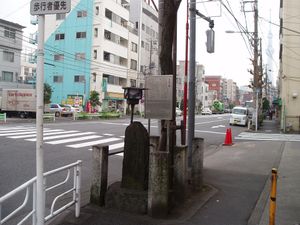
Gojukken Road and the Koshodo Site
- Fri
- 11:00–18:00
- Sat
- 09:30–18:00
- Sun
- 09:30–18:00
- Hours
- These are the hours of the Ukiyo-e Cafe Tsutaju museum-cafe near the presumed Koshodo site; holidays and irregular closures may vary.
- Price
- Admission is free; one drink must be ordered per person, but the drink price was not stated.
- How to visit
- The exact historical location of Koshodo is unknown; it is presumed to have been around Senzoku 4-11 along the surviving Gojikken-dori. The Ukiyo-e Cafe Tsutaju at 4-11-16 Senzoku offers related exhibits; advance reservation is recommended on weekends, and peak-time visits are limited to one hour.
- Hours
- Free entry
- Hours
- About 15 min

Why it is worth the detour
The surviving S-shaped approach concealed the interior of Yoshiwara from travelers on the embankment. Here the young publisher Tsutaya Juzaburo opened Koshodo, selling and publishing guidebooks that catalogued the quarter and eventually turning Yoshiwara gossip, fashion and personalities into mass media.
Gojukken Road features a unique S-shaped design that historically concealed Yoshiwara from view. It is also the site where Tsutaya Juzaburo published influential guidebooks on the area's culture.
The people behind this address
Documented connections, not celebrity trivia.
Tsutaya Juzaburo
He opened the Koshodo publishing shop on this approach and produced influential Yoshiwara guides and popular books.

What else is close by
The nearest places we have written up, with straight-line distance from here.
100 m
Mikaeri Yanagi
Customers departing Yoshiwara were said to pause beside this willow and look back regretfully, giving it the name “Looking-Back Willow.” The present tree is a later replacement and has been moved from its original position beside the Sanya Canal, but it remains the quarter’s most evocative farewell marker.
100 m
Yoshiwara Park and the Daimonjiro Site
The park occupies the former grounds of Daimonjiro, one of late Yoshiwara’s great high-ranking brothels. Its open footprint gives an unusual sense of how enormous a prestigious establishment could be before fires, earthquake destruction and postwar redevelopment erased the buildings.
100 m
Ohaguro Ditch Wall Remnant
Yoshiwara was once encircled by the broad, foul-water Ohaguro Ditch, a physical barrier designed in part to obstruct escape. A small section of dark stonework and the abrupt changes in ground level near the former gate are identified locally as remnants of that boundary, though the attribution is not completely certain.
200 m
Nakanomachi Street
This ordinary-looking road follows Yoshiwara’s former central ceremonial avenue. Courtesan processions advanced along it in towering footwear, while temporary cherry trees were planted for spring displays—an elaborate theatrical landscape erected inside a district whose women were tightly confined.
300 m
Yoshiwara Shrine
This small shrine combines five Inari shrines that once guarded the entrance and corners of the enclosed pleasure quarter; Yoshiwara Benzaiten was later added as a sixth deity. Courtesans prayed here for protection and professional success, making it one of the few surviving institutions shaped by the women of Yoshiwara themselves.
400 m
Ichiyo Memorial Museum
The museum preserves Ichiyo’s draft of “Takekurabe,” her shop ledger and a model reconstructing the neighborhood beside Yoshiwara. The model makes the vanished landscape unusually legible: her tenement faced toward the quarter’s ditch, walls and emergency gate.


Walk it with the stories
This address is one stop among many. Our routes and quests link them into a walk that makes sense on the ground.