Titel und Fotos, ohne die Geschichten: die schaltest du frei. Nichts davon ist ein Spoiler.
4
Former Ticosa Silk-Printing Works and Santarella Power House
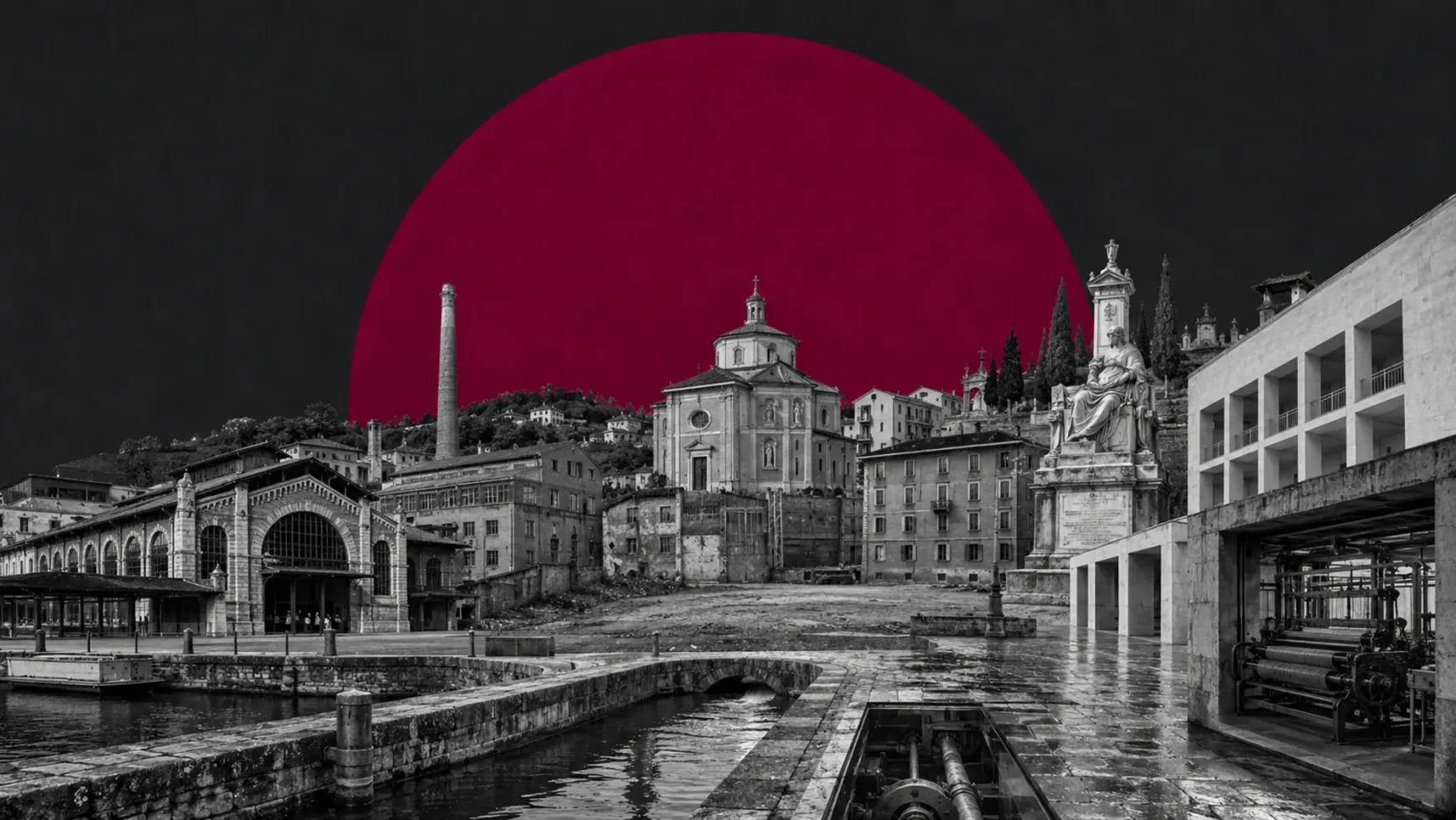
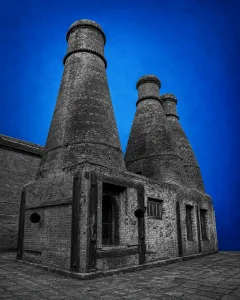
This striking void in central Como was once Ticosa, a major silk-dyeing and printing complex. Most of it has vanished, leaving the Santarella power house and a northern industrial section as fragments of the city behind the luxury label.
5
Mantero Family Aedicule
Designed in 1930 for the Mantero family, this monument connects Como’s monumental cemetery with one of the city’s enduring silk dynasties. It shows how textile wealth shaped not only factories and homes, but the architecture of family memory.
6
Sant'Elia Nursery School
Giuseppe Terragni designed this light-filled 1930s nursery for Como’s rapidly growing workers’ district. Its glass walls, garden and carefully arranged rooms reveal the childcare infrastructure behind the city’s textile economy.
7
Via Alciato Workers’ Quarters
These pastel-colored housing groups, traditionally known as the Trieste and Volta quarters, preserve the domestic side of Como’s industrial expansion. They recall a neighborhood organized around working families, particularly women employed in textile production.
8
Viganò Workers’ Courtyard
The first nucleus of workers’ housing created by Como’s Cooperativa Edificatrice, this courtyard records how textile workers responded collectively to the housing pressure caused by industrial growth.
9
Via Anzani Workers’ Housing
Two apartment blocks are all that remain of an ambitious Fascist-era plan for a self-contained workers’ district at Rebbio. Budget cuts killed most of the scheme, but the buildings’ galleries and orientation preserve the planning ideas of Terragni and Sartoris.
10
Paolo Carcano Silk Institute
Founded in 1868 to train textile workers, the Setificio helped Como compete in international fashion by educating chemists, designers and weaving specialists. Its present campus reflects the silk industry’s shift from inherited workshop skills to technical research and design education.
11
Como Silk Museum
A museum in Como devoted to silk, located in the San Martino district.
12
Where the Cosia Disappears at Via Piave
Here, the Cosia torrent runs visibly beside Via Castelnuovo and Via Piave, then abruptly disappears beneath central Como on its way to the lake. Its covering concealed a flood-prone watercourse that repeatedly damaged the city around it.
13
Former Giovanni Bianchi Silk Workshop
Hand-weaver Giovanni Bianchi opened his workshop here in 1866, filling it with looms and unusually long tables for printing silk and chiffon by hand. The family business later moved outside Como, adopted new technology, and developed into modern export production.
14
Historic Mantero Silk Headquarters
Silk merchant Riccardo Mantero commissioned his much younger brother Gianni to combine the family home, company offices and warehouses in one headquarters. The unusual complex became the launchpad for Mantero’s growth into an integrated international silk manufacturer.
15
Former Royal Silk School
Built between 1908 and 1910 for Como’s expanding state silk school, this building provided laboratories and classrooms for the city’s dominant industry. Today it houses the Teresa Ciceri high school, so an important piece of textile history is hiding in plain sight.
+2 Stationen
So funktioniert es
Hier oder in der App freischalten — einmal zahlen, kein Abo.
Einmal herunterladen; Audio und Karte laufen ohne Empfang.
In deinem Tempo gehen, jederzeit anfangen und aufhören.
Конспект города за одну прогулку: собор, у которого на фасаде язычники, дом-манифест из стекла, площадь, пережившая собственное затопление, электрическая скульптура посреди воды и фуникулёр в альпийскую деревню.
Почему мировая слава двести лет прячется на этом озере? 23 остановки, беглая королева со шпионами у ворот, Висконти, Версаче и деревня, оштрафовавшая поклонников Клуни.
Кто нарисовал самую знаменитую картинку Италии? День за рулём вокруг озера: виллы Бонда и «Дома Gucci», мраморная дуэль двух сановников, паром с машиной через воду и финал с лучшим видом на Комо.