Como
The invisible city: Como in silk
Ready-made route
Check the label on your scarf: Paris? Milan? A shop-floor detective story about who really weaves the world's luxury — and why this city hides its own rivers under the pavement.
- 3 hDuration
- 7 kmDistance
- 17Stops
- 19 people are looking at this
- Last unlocked about an hour ago
What's included
- Audio guide for every stop
- Works offline once downloaded
- Walking map with the exact order
- Yours to keep, no subscription
Coming soon
You can browse the whole walk now. Buying opens a little later.
The walk, stop by stop
The first three stops are free to read here — the rest come with the route in the app.
Como San Giovanni Railway Station
Piazza San Gottardo 5

- The Como San Giovanni station-name signs on the platforms
- Milan- and Chiasso-bound services on the departure board
- The passenger building viewed from Piazza San Gottardo
Corporate Relay Race
Running the station is a team effort: Rete Ferroviaria Italiana manages the station, Centostazioni handles the passenger building’s commercial area, and Trenitalia operates the trains. All three belong to Italy’s state-owned Ferrovie dello Stato Italiane group. One station, three lanyards.
Not the Only Como
San Giovanni is Como’s main station, but the city has four. The others are Como Borghi, Como Camerlata, and Como Nord Lago. Check the exact station name on your ticket—a small detail with excellent potential to ruin a departure.
Como San Giovanni is a terminus of the Como–Lecco railway, but the route does not branch off at these platforms. It splits from the Milan–Chiasso line several kilometres south, at Albate-Camerlata.
Open in MapsBruno Pessina Workers’ Houses and Factory Chimney
Via Borgo Vico 139, Como
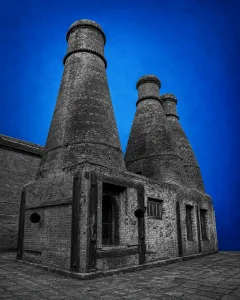
- The surviving factory chimney above the surrounding buildings
- The former workers’ houses on Borgo Vico
- A street-level view that includes both the houses and the chimney
Fifteen Years in the Making
The Bruno Pessina silk dyeing and printing works were built between about 1910 and 1925. The surviving workers’ houses and chimney still mark the former industrial site among today’s buildings.
A Serious Workforce
During the 1930s, the plant employed roughly 90 to 160 people. That range gives these quiet remnants their human scale: this was not just a chimney, but part of a working factory complex.
The Bruno Pessina works handled both silk dyeing and printing, combining two stages of textile production at the same plant.
Open in MapsBasilica of Sant'Abbondio
Via Regina, 35
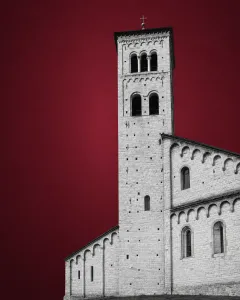
- The Romanesque exterior
- The basilica’s full outline from farther back
- The contrast between the church and Via Regina
Beyond Como’s Greatest Hits
Sant'Abbondio sits in the San Bartolomeo district, at Via Regina 35. It is one of Como’s more offbeat stops, away from the obvious headline sights.
Nine Centuries in One Glance
Sant'Abbondio is a Catholic basilica dating to the 11th century. Its architecture is Romanesque, placing more than 900 years between its medieval origins and your visit.
Even the final year of the 11th century was more than 900 years ago. Sant'Abbondio dates to that century.
Open in Maps
What comes after the free stops
Titles and photos, without the stories: those are what you unlock. Nothing here is a spoiler.
Former Ticosa Silk-Printing Works and Santarella Power House
This striking void in central Como was once Ticosa, a major silk-dyeing and printing complex. Most of it has vanished, leaving the Santarella power house and a northern industrial section as fragments of the city behind the luxury label.
Mantero Family Aedicule
Designed in 1930 for the Mantero family, this monument connects Como’s monumental cemetery with one of the city’s enduring silk dynasties. It shows how textile wealth shaped not only factories and homes, but the architecture of family memory.
Sant'Elia Nursery School
Giuseppe Terragni designed this light-filled 1930s nursery for Como’s rapidly growing workers’ district. Its glass walls, garden and carefully arranged rooms reveal the childcare infrastructure behind the city’s textile economy.
Via Alciato Workers’ Quarters
These pastel-colored housing groups, traditionally known as the Trieste and Volta quarters, preserve the domestic side of Como’s industrial expansion. They recall a neighborhood organized around working families, particularly women employed in textile production.
Viganò Workers’ Courtyard
The first nucleus of workers’ housing created by Como’s Cooperativa Edificatrice, this courtyard records how textile workers responded collectively to the housing pressure caused by industrial growth.
Via Anzani Workers’ Housing
Two apartment blocks are all that remain of an ambitious Fascist-era plan for a self-contained workers’ district at Rebbio. Budget cuts killed most of the scheme, but the buildings’ galleries and orientation preserve the planning ideas of Terragni and Sartoris.
Paolo Carcano Silk Institute
Founded in 1868 to train textile workers, the Setificio helped Como compete in international fashion by educating chemists, designers and weaving specialists. Its present campus reflects the silk industry’s shift from inherited workshop skills to technical research and design education.
Como Silk Museum
A museum in Como devoted to silk, located in the San Martino district.
Where the Cosia Disappears at Via Piave
Here, the Cosia torrent runs visibly beside Via Castelnuovo and Via Piave, then abruptly disappears beneath central Como on its way to the lake. Its covering concealed a flood-prone watercourse that repeatedly damaged the city around it.
Former Giovanni Bianchi Silk Workshop
Hand-weaver Giovanni Bianchi opened his workshop here in 1866, filling it with looms and unusually long tables for printing silk and chiffon by hand. The family business later moved outside Como, adopted new technology, and developed into modern export production.
Historic Mantero Silk Headquarters
Silk merchant Riccardo Mantero commissioned his much younger brother Gianni to combine the family home, company offices and warehouses in one headquarters. The unusual complex became the launchpad for Mantero’s growth into an integrated international silk manufacturer.
Former Royal Silk School
Built between 1908 and 1910 for Como’s expanding state silk school, this building provided laboratories and classrooms for the city’s dominant industry. Today it houses the Teresa Ciceri high school, so an important piece of textile history is hiding in plain sight.
+2 stops
How it works
- Unlock it here or in the app — one payment, no subscription.
- Download it once; the audio and the map work without signal.
- Walk at your own pace, start and stop whenever you want.
Coming soon
You can browse the whole walk now. Buying opens a little later.