Tokyo
Архитектура
От кирпича Тацуно Кинго на вокзале до кокона у западного выхода Синдзюку. Тангэ дважды: крыша на тросах 1964 года и две башни мэрии 1991-го. Ле Корбюзье в Уэно, Кума в Нэдзу и Кабуки-дза, аллея флагманов на Омотэсандо. Храм с индийским фасадом и органом, русский собор на холме, османская мечеть на Ёёги-Уэхара. И две башни, которые строили ради телесигнала. Стеклянный корабль Форума, необарочный дворец Акасака, восьмиугольник Будокана, низ 1934 года под башней Кудан Кайкан, восстановленный фасад первого вокзала и Красные ворота Тодая.
Viewpoint
Tokyo Metropolitan Government Building
Kenzo Tange's twin-towered city hall combines monumental late-modern architecture with free observatories overlooking the metropolis.
Architecture
Mode Gakuen Cocoon Tower
The Mode Gakuen Cocoon Tower is best known for its unique cocoon-shaped architectural design.
Architecture
Yoyogi National Gymnasium
Kenzo Tange's 1964 Olympic swimming hall with a suspended roof hung from two masts, a landmark of modern architecture.
Museum
National Museum of Western Art
Le Corbusier's only building in East Asia (1959, UNESCO), built around the Matsukata collection of Monet and Rodin.
Street & district
Omotesando
The zelkova-lined approach to Meiji Shrine turned into Tokyo's showcase of flagship-store architecture by Ando, Ito, Herzog & de Meuron and SANAA.
Museum
Nezu Museum
Home to a vast collection of pre-modern Japanese and East Asian art, including National Treasures.
Church
Tsukiji Honganji Temple
Chuta Ito's 1934 temple blends Buddhist functions with an extraordinary facade inspired by ancient Indian architecture.
Church
Holy Resurrection Cathedral
Completed in 1891 under Saint Nicholas of Japan, the Orthodox cathedral introduced a striking Byzantine dome to the Meiji capital.
Transport landmark
Harajuku Station
Harajuku Station is best known for being a major transport hub near the vibrant Harajuku district, famous for its youth culture and fashion.
Theatre & culture
Tokyo International Forum
Rafael Viñoly's immense ship-like glass atrium occupies the former city-hall site and became a landmark of 1990s Tokyo architecture.
Palace & fortress
State Guest House Akasaka Palace
Built in 1909 for the crown prince, this lavish neo-Baroque palace demonstrates Meiji Japan's ambition to stand among the world's great powers.
Stadium
Nippon Budokan
Built for martial arts, Budokan became a contested symbol of rock’s arrival when the Beatles played five concerts here between June 30 and July 2, 1966. In 1978, Cheap Trick recorded the roaring performances that became Cheap Trick at Budokan, an album whose success helped turn the hall’s name into international shorthand for a career-defining Japanese concert.
Architecture
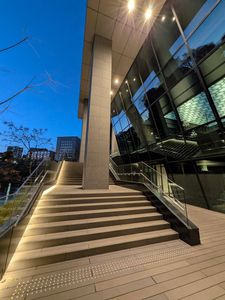
Kudan Kaikan Terrace
The preserved façade belongs to the former Military Hall, which became martial-law headquarters during the February 26 Incident. Officers drafted the famous radio appeal urging enlisted rebels to return to their units here, and it was broadcast from the building on February 29, helping end the standoff.
Transport landmark
Old Shimbashi Station
Japan's first railway terminus opened here in 1872, burned after the 1923 Great Kanto Earthquake, and disappeared beneath the vast Shiodome freight terminal. Redevelopment uncovered its foundations in 1991; the reconstructed station now stands above protected remains that can be viewed through a glass floor.
Architecture
University of Tokyo Red Gate (Akamon)
The 1827 vermilion gate built by the Maeda lords to receive a shogun's daughter as a bride, now the symbol of Japan's top university.