Guangzhou
История
Две тысячи лет на одном месте: царство Наньюэ под стеклом, минская башня, Тринадцать факторий и Опиумные войны, мемориалы 1911 и 1925 годов, штабы Сунь Ятсена, академия Хуанпу, мост, взорванный в 1949-м. Мемориальные точки — в серьёзном регистре, без шуток и в карточках, и в будущих рассказах.
Museo
Nanyue King Museum
The Nanyue King Museum is best known for its archaeological exhibits of the ancient Nanyue kingdom, including the well-preserved tomb of King Zhao Mo.
Sito archeologico
Site of Nanyue Kingdom Palace
The Nanyue King Museum is best known for its archaeological exhibits of the ancient Nanyue Kingdom, including the well-preserved tomb of King Zhao Mo.
Museo
Whampoa Military Academy
The original site of the Whampoa Military Academy, a significant military and political school founded by Sun Yat-sen.
Museo
Guangzhou Thirteen Factories Museum
The museum stands within the former riverfront district where foreign merchants were confined under the Canton System. Its maps, trade goods and reconstructed interiors explain how tea, silk and porcelain fortunes collided with opium smuggling, diplomatic pressure and the destruction of the factories in 1856.
Monumento
Memorial to the Shakee Massacre
A memorial commemorating the victims of the Shakee Massacre in 1925.
Cimitero
Cemetery of 72 Martyrs of Yellow Flower Mound
A memorial park dedicated to the 72 martyrs of the 1911 Yellow Flower Mound Uprising.
Museo
Peasant Movement Training Institute
In 1926 Mao directed the sixth class of the Peasant Movement Institute, housed in the old Confucian temple of Panyu county.
Museo
Guangzhou Uprising Memorial Hall
This compound was the city's police headquarters until insurgents seized it during the December 1927 Guangzhou Uprising and proclaimed an urban Soviet government. Visitors can trace the brief regime through its government offices, Red Guard command post, guard quarters and former detention building—the physical rooms of a revolution that survived only days. ([wglj.gz.gov.cn](https://wglj.gz.gov.cn/ztmb/gzhyn/ajjq/4a/content/post_8930900.html?utm_source=openai))
Museo
Memorial Museum of Generalissimo Sun Yat-sen's Mansion
The Memorial Museum of Generalissimo Sun Yat-sen's Mansion is known for being a historical site where Sun Yat-sen established his military headquarters.
Museo
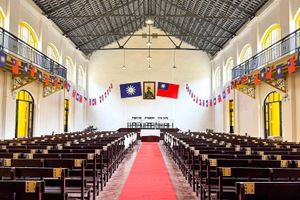
Former Site of the First National Congress of the Kuomintang
Sun Yat-sen convened the Kuomintang's transformative 1924 congress inside this clock-towered school building, formalizing cooperation with Chinese Communists and the policies of alliance with Soviet Russia and support for workers and peasants. Three years later Lu Xun lived in the same building and wrote about its old clock tower, giving the revolutionary venue an unexpected literary afterlife. ([wglj.gz.gov.cn](https://wglj.gz.gov.cn/visitgz/f/res/doc/%E5%8C%97%E4%BA%AC%E8%B7%AF%E6%96%87%E5%8C%96%E6%A0%B8%E5%BF%83%E5%8C%BA%E5%AF%BC%E6%B8%B8%E8%AF%8D.pdf?utm_source=openai))
Architettura
Former Soviet Consulate
Known as Shamian's Western Red Building, this consulate was swept into the violence following the failed Guangzhou Uprising in December 1927. Nationalist forces raided the mission, arrested its staff and executed five Soviet employees and several Chinese employees, helping precipitate China's break in relations with the Soviet Union.
Piazza
Haizhu Square (Guangzhou)
Haizhu Square is known for its granite soldier statue commemorating the liberation of Guangzhou.
Lungomare
Tianzi Pier
The oldest wharf on the Pearl River in Guangzhou, known for its historical significance.
Sito archeologico
Huangpu Ancient Port
During the Canton System, foreign ocean-going ships were ordered to anchor at Whampoa rather than sail directly to the Thirteen Factories. Cargo was registered, inspected and transferred into smaller boats here, making this quiet inlet the outer-port counterpart to the crowded merchant enclave upriver.
Vie e quartieri
Shamian Island
A historical area with colonial European architecture and tranquil pedestrian avenues.
Architettura
Pan Family Compound
This surviving compound was developed around 1826 by Pan Zhengwei, heir to one of the most powerful Thirteen Factories merchant families. Pan combined collecting and refined domestic architecture with the dangerous obligations of a hong merchant, later contributing heavily to Guangzhou's defense during the First Opium War.
Mercato
Qingping Market
A historic market known for traditional Chinese herbs and exotic animal trade.
Monumento
Five-Ram Sculpture
The Five-Ram Sculpture is known for being an emblem of Guangzhou, symbolizing good luck.
Museo
Sanyuanli People's Anti-British Struggle Memorial Hall
Villagers gathered at this former temple before confronting British troops outside Guangzhou in May 1841. Now a memorial museum, it preserves weapons, flags and accounts of the Sanyuanli resistance, one of the most consequential local reactions to the First Opium War.
Museo
Liede Village History Museum
Liede changed from a water village crowded with handshake buildings into a high-rise enclave of 37 residential towers at the edge of Guangzhou's new business district. The village history museum, deliberately conceived as a repository of nostalgia, uses donated objects and reconstructed scenes to tell what was lost when fields, lanes and rental rooms became premium real estate.
Museo
Liwan Museum (Chen Lianzhong Residence)
Silk merchant and HSBC comprador Chen Lianzhong built this hybrid mansion with European arches, columns and a Chinese garden beside the old waterways. Now incorporated into Liwan Museum, it stands beside a reconstructed Xiguan mansion whose interiors explain how wealthy merchant families actually lived behind their imposing doors.