Como
Como in half a day: the essentials
Ready-made route
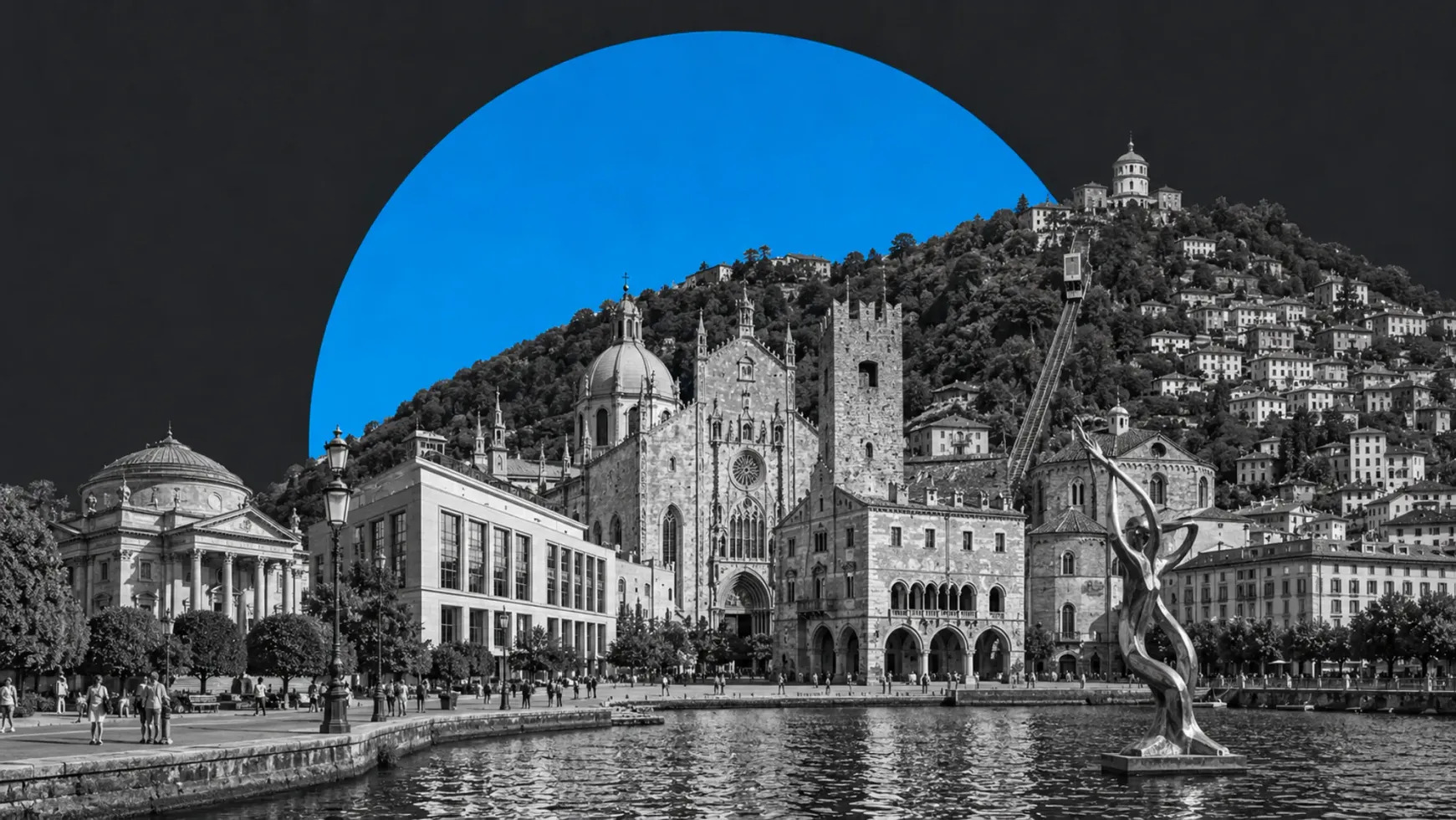
The whole city in one walk: a cathedral with pagans on its façade, a glass manifesto of a house, a square that used to be a harbour, an electric sculpture out on the water, and a funicular to an Alpine village.
- 2.5 hDuration
- 6 kmDistance
- 13Stops
- 44 people are looking at this
- Last unlocked about an hour ago
What's included
- Audio guide for every stop
- Works offline once downloaded
- Walking map with the exact order
- Yours to keep, no subscription
A first-day overview of Como: the city’s essential landmarks in a sensible order, without rushing and without pointless detours. We start at the medieval Porta Torre gate, walk the old town — San Fedele, the Broletto and the cathedral with its famous pagan neighbours on the façade — then look in on the opera house and the most disputed Italian building of the twentieth century. Beyond that, the lakefront and the city’s scientific fame: Piazza Cavour, the Volta monument and his temple-museum, the rationalist manifesto of Novocomum, neoclassical Villa Olmo and the Life Electric sculpture out on the lake. The finale is the funicular to Brunate: seven minutes, and the whole route lies below you like a map. Every stop tells its own story — you can start anywhere, but the order is chosen so the city opens gradually.
Coming soon
You can browse the whole walk now. Buying opens a little later.
The walk, stop by stop
The first three stops are free to read here — the rest come with the route in the app.
Porta Torre
Largo Miglio, Como

In 1127, Milan had won, and Como’s Roman defenses lay demolished. The tower in front of you is Como’s reply—delivered in stone and aimed directly down the road toward its former enemy.
In 1127, Milan won the Ten Years’ War, and Como’s Roman defenses were demolished. The tower in front of you came later: not as decoration, but as proof that the defeated city had rebuilt. Pause at the base and look all the way up. Forty metres of fortified stone is not a subtle comeback. After the defeat, Como allied with Frederick Barbarossa and rebuilt its walls. The city had recovered its independence, and its main entrance needed defending. Porta Torre became the blunt final statement. Now step closer to the base. From a distance, the tower reads as a city landmark; up close, its original purpose takes over. Anyone using Como’s main entrance would have passed beneath this fortified structure. Completed in 1192, the tower arrived 65 years after Milan’s victory. That gives the story its turn: Roman defenses destroyed, Como defeated, then a new alliance, rebuilt walls and a gate tower announcing that the city could defend itself again. Turn around and look toward the road leading to Milan. That orientation gives Porta Torre its sharpest edge. The tower did not face just anywhere—it faced the city that had defeated Como. Before you leave, step back into Largo Miglio, keeping clear of traffic, and look at the whole 40-metre silhouette. Porta Torre still works best from here: first as a wall of stone, then as a very pointed message.
- The full 40-metre silhouette from Largo Miglio
- The fortified base at Como’s former main entrance
- The side facing the road toward Milan
Forty Metres of No
Porta Torre rises 40 metres above Como’s main medieval entrance. This was no decorative flourish: it was built to defend the gateway. Step back into Largo Miglio to take in its full height.
The Other Name
Porta Torre is also known as Torre di Porta Vittoria. Whichever name you use, the message is hard to miss: Como wanted its main entrance to look thoroughly defended.
Porta Torre faced the road to Milan—the city whose victory had left Como’s Roman defenses demolished. It was, in effect, a 40-metre stone reply aimed at the former enemy.
Open in MapsBasilica of San Fedele
Piazza San Fedele, 22100 Como
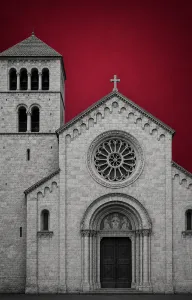
Volta had been dead for just one week when Como gathered inside this church to decide how he would be remembered. A young priest arrived with a commemorative poem—and soon wrote the inventor’s first biography.
Volta had been dead for only seven days when Como gathered right here for a civic tribute. The city was mourning, but it was also beginning the work of public memory: deciding how the inventor’s life would be told. Start in the middle of Piazza San Fedele and face the basilica. The present Romanesque church dates to 1120, but today its most striking story begins with that gathering after Volta’s death. For the tribute, a young priest named Tommaso Bianchi was asked to compose a commemorative poem. He soon went further and produced the first biography of Volta. A piece written for one ceremony became the starting point for a much larger public story. That is San Fedele’s turn in the drama. First came the loss, then the civic tribute, then a biography that helped transform the recently deceased physicist into a public legend. Memory moved quickly: one week after Volta’s death, Como was already assembling the words through which later readers would meet him. Now walk toward the entrance. If the doors are open, step inside and pause near the threshold. This was the setting for the tribute—not a later monument or museum, but a church in the center of Volta’s own city. Before you leave, turn back toward the piazza. The essential detail is easy to miss because there is no special object to hunt for: the building itself is the stage. You can study the exterior from the square, and if the basilica is open, enter the space where Como’s mourning began to turn into public memory.
- The basilica entrance from Piazza San Fedele
- The Romanesque church from the middle of the square
- The interior where Como held its civic tribute to Volta
The Church You See: 1120
The present Romanesque church dates to 1120. Step into the middle of Piazza San Fedele and look back at the building as a whole: medieval Como is still right there in the city center.
Fidelis of Como
The basilica is dedicated to Fidelis of Como. Saint, church and city are tied together in the name San Fedele.
Como held its civic tribute to Volta inside San Fedele just one week after his death. Tommaso Bianchi, the young priest asked to write a commemorative poem, soon produced the inventor’s first biography.
Open in MapsBroletto
Piazza Duomo 2, Como
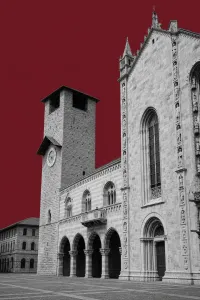
A bell rings over medieval Como, citizens converge on the square, and civic power plants itself between cathedral and bishop’s palace. Then factional conflict brings fire—and the expanding cathedral claims part of what survives.
A bell rings over medieval Como, and citizens make their way toward this building. Public business is about to begin. No notifications, no group chat—just one very loud civic alert. Step back and take in the Broletto with its powerful neighbors. The town hall was deliberately placed between the cathedral and the bishop’s palace. Como’s civic authority was not tucked away: it occupied the same space as the city’s religious power. This was where citizens gathered for public assemblies. The Broletto also housed administration and justice, while its bell called people into the square. Government here was something you could hear—and physically gather around. Then came the fall. In 1408, during the struggle between the Rusca and Vittani factions, the Broletto burned. A building created for civic government became a casualty of political conflict. Its losses continued later. Turn toward the Broletto’s southern end, nearest the cathedral. As the cathedral construction site expanded, it demanded more room. Part of that end was removed, and the external staircase disappeared with it. The cathedral’s growth physically reduced its civic neighbor. Now look along the cathedral-facing edge and notice how tightly the buildings sit together. That compressed relationship is part of the Broletto’s biography: first a bold position between major powers, then fire, then the loss of masonry and access space as the cathedral expanded. What survived still lets you read Como’s medieval power map. Before leaving Piazza Duomo, walk a few steps away and turn back. From the wider angle, take in the Broletto, cathedral, and bishop’s palace together—the whole argument in stone.
- The Broletto positioned between the cathedral and the bishop’s palace
- The cathedral-facing southern end, reduced during the cathedral’s expansion
A Northern Italian Family
Como’s Broletto belongs to a family of civic buildings found across northern Italy. Milan, Brescia, Pavia, Piacenza, Monza, Novara, and several other cities have their own broletti: places for public assemblies, administration, and justice.
From Orchard to Town Hall
The word “broletto” came through Medieval Latin and probably derives from a Celtic word. It first meant a small orchard or garden, then a field enclosed by a wall. A word for fenced greenery somehow ended up attached to the machinery of communal government.
The expanding cathedral construction site claimed part of the Broletto’s southern end and its external staircase. The close fit you see today came at the town hall’s expense.
Open in Maps
What comes after the free stops
Titles and photos, without the stories: those are what you unlock. Nothing here is a spoiler.
Como Cathedral
A floor plaque commemorates an easily forgotten side of Volta: according to tradition, the elderly scientist attended Mass here every day. It was installed in 1999 for the bicentenary of the battery.
Teatro Sociale
Como’s neoclassical theatre has survived construction disasters, overcrowding, conversion into a cinema, and structural closure. In 1944, it even became the substitute opera house for Milan’s war-damaged La Scala.
Palazzo Terragni (Casa del Fascio)
Giuseppe Terragni’s former Fascist Party headquarters is considered a masterpiece of Italian Modern Architecture. Its later occupants chart Italy’s political reversal: liberation parties first, then the Finance Police.
Piazza Cavour and the Exhibition That Rose Twice
In 1899, a vast temporary exhibition celebrating the battery stretched from Piazza Cavour into Como’s lakeside gardens. A short circuit destroyed it, but the city built a second exhibition in less than two months.
Monument to Alessandro Volta
Pompeo Marchesi’s marble statue turned Alessandro Volta, inventor of the first electrical battery, into Como’s secular civic hero. Its remarkably brief dedication also helped give the entire square Volta’s name.
Tempio Voltiano
A Neoclassical museum on Lake Como dedicated to local physicist Alessandro Volta, inventor of the first electrical battery. Its collection includes Volta’s original scientific instruments, personal belongings and honours.
Novocomum
Novocomum is the apartment block Giuseppe Terragni slipped past the authorities using conservative-looking plans, only to unveil a radically avant-garde building behind the scaffolding. The resulting scandal became an early battle over Italian Rationalism.
Villa Olmo
Villa Olmo became the main exhibition ground for the 1927 centenary of Volta’s death. Temporary pavilions connected his experimental pile to hydroelectric power, telephony, telegraphy, and the vast electrical industries that followed.
Life Electric
Daniel Libeskind’s contemporary sculpture on Lake Como, dedicated to physicist Alessandro Volta and completed in 2015.
Como–Brunate Funicular
Opened in 1894, this funicular replaced a laborious mule-track ascent with a rapid climb of roughly 500 vertical metres. It helped turn secluded Brunate into a Belle Époque resort filled with hotels, restaurants and extravagant villas.
How it works
- Unlock it here or in the app — one payment, no subscription.
- Download it once; the audio and the map work without signal.
- Walk at your own pace, start and stop whenever you want.
Coming soon
You can browse the whole walk now. Buying opens a little later.