Tokyo
Другой Токио
Город, который живёт между открытками: подземная площадь, которую переименовали в «проход», чтобы запретить митинги; станция-призрак с кроликом под куполом; улица, петляющая по спрятанной реке; камень на месте моста, которого нет. И люди сегодняшнего города: хозяева стоек якитори в Омоидэ-ёкотё, где ширина лавки — ширина послевоенного ларька; рассказчики ракуго в деревянном Суэхиротэй; лавочники Янака-Гиндзы, которые придумали кошек на крышах, чтобы выстоять против супермаркета; повара мондзя на Цукисиме, выдающие лопатку гостю. Сюда — после того, как главное уже видел. И ещё: череп куртизанки в святилище у офисной стены, аллея Гармоника, десять этажей манги в Накано, одиннадцатиметровый повар над Каппабаси, пруд Сансиро, подвалы Симокитадзавы и букинисты Дзимботё.
Square
Shinjuku Station West Exit Underground Plaza
In 1969, a handful of anti-Vietnam War singers with guitars grew into weekly gatherings of several thousand people here. Authorities countered by changing signs from "West Exit Underground Plaza" to "West Exit Underground Passage" and deploying riot police, turning a single word on a sign into an argument over who controlled public space.
Transport landmark
Former Hakubutsukan-Dobutsuen Station
This unexpectedly grand little station opened in 1933 on former Imperial land to serve Ueno Zoo and the museums. Falling passenger numbers ended service in 1997, but its Western-style entrance survived closure and redevelopment as a sealed architectural ghost beside Ueno Park, occasionally opened for special programs.
Monument
Sukiyabashi Bridge Monument
This small monument recalls the bridge that carried travelers across Edo Castle's outer moat at the entrance to Ginza. The moat was filled and Sukiyabashi removed in 1958, turning a waterside gateway famous from the radio drama and film Kimi no Na wa into an ordinary patch of city ground.
Market
Omoide Yokocho
«Memory Lane» by Shinjuku's west exit: two alleys of tiny yakitori counters left over from the post-war black market.
Theatre & culture
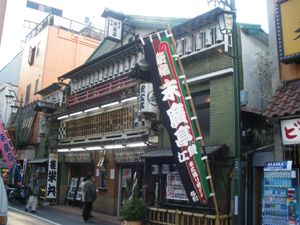
Shinjuku Suehirotei
This wooden rakugo theater became an unlikely angura venue in September 1967, when Shuji Terayama's Tenjo Sajiki presented its second production, "The Crime of Fatso Oyama," here. The collision of psychedelic experimental theater with a traditional vaudeville house captures the cultural disorder that made 1960s Shinjuku distinctive.
Church
Hanazono Shrine
In the summer of 1967, Juro Kara's Situation Theatre erected its first Red Tent in the shrine precincts, rejecting conventional playhouses for a temporary, carnivalesque stage. The performances made this working shrine one of the foundational locations of Japan's angura theater movement, and Red Tent productions have continued to return.
Church
Holy Resurrection Cathedral
Completed in 1891 under Saint Nicholas of Japan, the Orthodox cathedral introduced a striking Byzantine dome to the Meiji capital.
Church
Gotokuji Temple
Thousands of white cat figurines recall the legend of a beckoning cat that saved a feudal lord and inspired the maneki-neko tradition.
Church
Sengakuji Temple
The graves of the forty-seven ronin make this temple the central site for Japan's most famous tale of samurai loyalty and revenge.
Street & district
Tsukishima Monja Street
About 70 restaurants on one street serving monjayaki, the runny Tokyo cousin of okonomiyaki, cooked on the table griddle.
Market
Ameyoko Market
A post-war black market under the Yamanote tracks that became a 400-metre bazaar of fish, candy, sneakers and spices.
Street & district
Hoppy Street
A covered alley of open-front izakaya west of Senso-ji, named after Hoppy, the cheap beer-like drink of post-war Tokyo.
Architecture
Mode Gakuen Cocoon Tower
The Mode Gakuen Cocoon Tower is best known for its unique cocoon-shaped architectural design.
Street & district
Cat Street
The fashionable pedestrian lane between Shibuya and Omotesando follows a section of the old Shibuya River, covered around the time of the 1964 Tokyo Olympics. Houses originally turned their backs toward the water; once the channel became a street, former rear walls and service entrances were gradually transformed into shopfronts.
Street & district
Yanaka Ginza
A 170-metre shopping street of the old «shitamachi» with about 60 family shops, cat statues and the «sunset stairs» at its top.
Church
Takao Inari Shrine
This tiny shrine grew from the legend of Takao Dayu, a celebrated Yoshiwara courtesan supposedly murdered aboard a boat after rejecting the lord who purchased her contract. The shrine claims to enshrine a skull associated with her, but historians dispute both the murder story and the relic—making it a striking example of a courtesan becoming the center of an enduring urban ghost legend.
Market
Harmonica Alley
These cramped covered lanes began with the informal station-front market that appeared after Japan's defeat in 1945. The tiny shops were later nicknamed for their resemblance to the closely spaced holes of a harmonica, and the surviving maze remains a remarkably intact descendant of Tokyo's postwar black-market city.
Curiosity
Nakano Broadway
A 1966 shopping complex that became the collectors' mecca: Mandarake floors of manga, figures, watches and vintage toys.
Street & district
Kappabashi Kitchenware Street
An 800-metre street of about 170 shops selling knives, pots and the plastic food replicas seen in restaurant windows.
Park & garden
Sanshiro Pond
This former daimyo-garden pond acquired its everyday name from Soseki's novel Sanshiro. In the book, the inexperienced student Sanshiro first encounters the mysterious Mineko here, and the fictional meeting became so famous that it displaced the pond's formal name in popular speech.
Street & district
Shimokitazawa
A low-rise maze of vintage shops, small theatres and live houses two stops from Shibuya — Tokyo's indie quarter.
Street & district
Jimbocho Book Town
About 130 second-hand bookshops in one quarter, the largest concentration in the world, grown around the universities since the 1880s.